
Shakespeare monologue
Mercutio's Queen Mab Speech
Shakespeare’s Queen Mab speech is perhaps one of the most famous speeches he ever wrote. The speech is from Romeo and Juliet. In the setting of the show the speech is used by Mercutio in order to point out Romeo’s visions of love and how it can be so misleading. Within the show he is trying to get Romeo to go to the Capulet feast. He uses the example of Queen Mab in order to establish that Romeo’s longing for Rosaline is pointless. There is also a deeper meaning found within the speech. The speech highlights Mercutio’s view that people’s dreams are directly related to who they are. He believes lovers will dream of love and soldiers will dream of battle. He is blatantly honest. There is also a sense of sexually to the piece. Mercutio is a “hot blooded” character. He acts on emotion and is quite sexual. His age and raging hormones add to his hot-blooded nature. He is a man of emotion. Ironically, he is as passionate about love as Romeo.
This speech is a journey. There are a ton of different emotions within the scene. My process for rehearsing this scene began with a script analysis. I tried to find the journey in which the character was taking. I discovered that the beginning of the speech is filled with irony and sexual undertones. Mercutio’s sexual nature is highlighted in the text. He has the ability to make anything become sexual. He describes the chariot in which Queen Mab arrives to bring dreams to the sleeping people. The speech takes a dramatic turn when he starts describing how Queen Mab causes a soldier to dream about “cutting foreign throats.” Mercutio becomes emotionally wrapped up in the words he is speaking. It seems as though he is an uncontrollable train that would have to crash if it were to stop. Ultimately, this is a speech is part of everyday guy talk. I imagined this speech to be what the crazy dude in gym class would say in the locker room.
I did not find it difficult to understand the heightened verse of the speech. The iambic rhythm of the piece allowed for quick memorization. I focused on finding the conversational quality and tone of the piece. It was important to me to make it seem like I was teasing Romeo. Mercutio is the alpha male between his groups of friends and this allows him to be able to have fun with his boys.
Despite how much of an alpha male Mercutio may be, there is a side of vulnerability within him. As the speech carries on, Mercutio gets wrapped up in the emotion of the piece. It seems as if he is remembering all of the wrongs love has done to him. He is blaming Queen Mab on this. This can be considered the dramatic climax of the piece. I love the fact that Mercutio shows an incredible amount of passion for anything he is saying. He wears his heart on his sleeve and he lets everything he is feeling out by getting caught up in emotion.
Wednesday, March 24, 2010

Wednesday, February 3, 2010
Response
Response
The Greek tragedies are some of the oldest know plays still in existence today. There are three major extant playwrights (Aeschylus, Sophocles, and Euripides) that have works still being produced thousands of years later. In my research I have found various production photos from the works of these Greek tragedians. I discovered a wide variety of elements to each production that make the individual production unique to the world the director was trying to create. Although none of the pictures are alike, I included pictures of the same play being produced by different companies and the world created by each playhouse was completely different and unique. This outcome allows me to make the assumption that classic Greek tragedy is easily adaptable and can allow the director and creative team to dream big and create extreme circumstances.
The extreme nature of the tragedies themselves helps show the flexibility of each piece. This flexibility allows the director to add his own texture and tone too the piece. For example, Sophocles’ Oedipus the King done by Ridge Theatre Company looks totally different than Phillip Seville’s 1967 performance of the same piece. Seville’s performance of the piece seems to have a detailed set and costume design that is quite natural and historically accurate for the time. Yet, Ridge Theatre Company’s 2008 production of the same piece has a minimalist approach toward the same design areas. In the Ridge Theatre Company production, the use of simple technology is embraced and projections are used to provide an inference of the setting of the play. These projections seem to all be historical pictures of actual Greek locations but the man playing Oedipus is clearly dressed in modern dress setting the play in a modern time. Time periods seem to be interchangeable with the piece.
In finding various pictures of the many productions of these Greek tragedians, I am amazed at how different the setting of each production looks throughout the time period. The example I listed above sites a trend in the movement and changes in style of a production. All of the pictures I found from earlier productions as in the 1950’s and 60’s have a realistic approach to their design and one can assume acting style. The 50’s highlighted the arrival of Method acting technique and realism. With the arrival of Brando in Tennessee Williams’ Streetcar Named Desire (1951), realistic acting approach was quite popular during the 50’s. The postmodern style movement in theatre seems to have had a heavy hand in influencing the plays from the 90’s and on. Minimalist sets with suggestive lights and costumes are all the rage right now. I am interested to see that the majority of the productions I have found in the 2000’s have no large-scale sets containing historically accurate scenic elements that set the play in a historical time. Instead, everything is quite minimal and the focus is more on the acting. Gone seem to be the epics of the 60’s. A good example of this can be found in Public Theatre’s 2009 production of Euripides' The Bacchae in which Jonathan Groff of Spring Awakening fame brings a modern touch to Euripides’ 2000+-year-old play.
Tuesday, February 2, 2010
22-25
 Euripides' Electra
Rush Rehm (2009)
Stanford University

Euripides' Electra
John Ulman(2010)
Seattle Shakes Co

Sophocles' Oedipus the King
Harry Parcht (2008)
ridge theatre

Sophocles' Oedipus the King
Sean Graney (2009)
The Hypocrates
17-21

Sophocles' Oedipus the king
Phillip Saville
(1967)

Sophocles' Oedipus at Colonus
Nicholas Rudail
The University of Utah (2003)
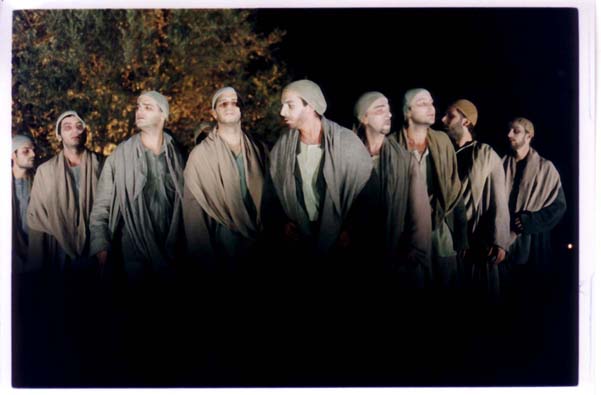 Sophocles' Oedipus at Colonus
Alexis Minotis (2003)
Art Theatre at the
Epidavros Festival
 Aeschylus' The Eumenides
Ted Hughes (2004)
Balcony Theatre

Aeschylus' The Eumenides
Ted Hughes (2004)
Union College
11-16
 Aeschylus' Seven Against Thebes
"The Seven"
Will Power (2006)
New York Theatre Workshop
 Aeschylus' Seven Against Thebes
Ellen Stewart (2004)
Great Jones Rep Company
 Euripides' Alcestis
Ted Hughes (2007)
Handcart Ensemble
 Euripides' Alcestis
E.a.Bongie (1951)
University of Illinois

Euripides' Alcestis
Ted Hughes
Bates College (2009)

Euripides' The Bacchae
JoAnne Akalaitis
Public Theater (2009)
7-10

Euripides' Trojan Women
Charles Mee
The Milk Can Theatre Company (2006)
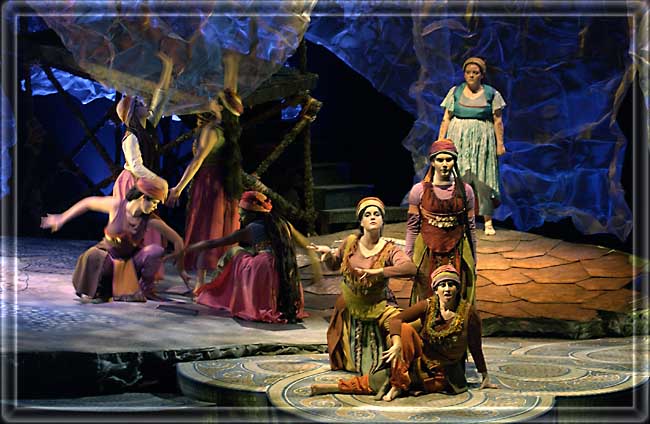
Euripides' Medea
Tom King
James Madison University (2008)

Sophocles' Antigone
Seven Tyrant
Dorothy Somerset Studio (2007)
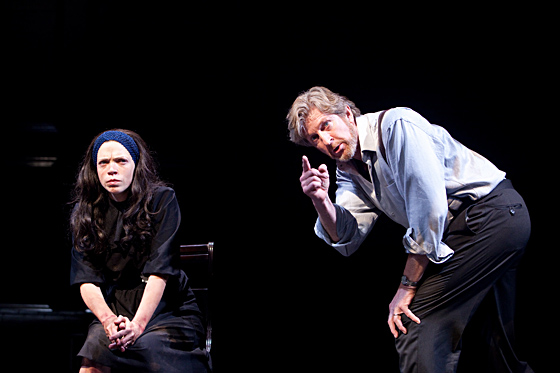
Sophocles' Antigone
Jean Anouilh (2009)
Soul Pepper
Jean Anouilh (2009)
Soul Pepper
4-6

Sophocles' Oedipus Rex
University at Albany State University of New York
Jarka Burian(1990)

Aeschylus’ The Persians
Shakespeare Theatre Company
(2006)
Shakespeare Theatre Company
(2006)
 Aeschylus' Libation Bearers
Keith Scales (1988)
Classic Greek Theater of Oregon
Subscribe to:
Posts (Atom)